• Skip to primary navigation
  • Skip to main content
  • Skip to primary sidebar

An Antic Disposition

  • Home
  • About
  • Archives
  • Writings
  • Links
You are here: Home / Archives for Rob

Rob

The Final OOXML Update: Part I

2009/10/01 By Rob 19 Comments

I have not written a blog post on OOXML for well over a year now. My last post on this topic was on August 17th, 2008 and covered the contentious appeals process which followed the DIS 29500 Fast Track ballot. So I hope that one more post, 14 months later, will not seem excessive to my critics. There is too much good stuff going on with ODF these days, with ODF 1.2 coming soon, inter-vendor work at plugfests, the ODF Toolkit, and continual national adoption, for me to waste much time on OOXML. “Let the dead bury their own dead” is my attitude here. That said, I have received several requests for an update on OOXML, so I will oblige with some quick observations in what (I hope) is my final update on this sad chapter in standardization.

I’ll structure this update over a handful of posts, each one looking at a single topic. In this post I’ll cover the tight control Microsoft maintains over the OOXML standard, despite their earlier assertions to the contrary.


From the beginning of the Fast Track procedure Microsoft encouraged NBs to approve OOXML with the promise that their approval of the specification would guarantee that it would be handed over to the “global community” for maintenance. Vote against the standard — because it was obviously flawed — and you would lose this unique opportunity to transfer control from proprietary interests at Microsoft to the benevolent and international meritocracy of ISO. This was one of the main “selling points” for OOXML and what Microsoft repeatedly sold.

For example, here was Jerry Fishenden, Microsoft’s National Technology Office in the UK:

There’s an easy question to consider here: would you prefer the Microsoft file formats to continue to be proprietary and under Microsoft’s exclusive control? Or would you prefer them to be under the control and maintenance of an independent, open standards organisation? I think for most users, customers and partners that’s a pretty easy question to answer: they’d prefer control and maintenance to be independent of Microsoft. And the good news is that the Open XML file formats are already precisely that: currently under the control of Ecma International (as Ecma-376) and, if the current voting process is positive, eventually under the control of ISO/IEC

Or Microsoft’s Jason Matusow:

I still hear patently untrue claims that MS controls Open XML – this wasn’t true following the adoption of Ecma 376, and is now permanently a moot argument.

Microsoft Australia said:

This is encouraging and should be a reminder to all that the Open XML standard will be controlled by the international community not by any commercial business or other organisation – including Microsoft.

Chris Capossela , Microsoft Senior VP said it thus:

If Open XML is approved as an ISO/IEC standard, the story would not end there – like any other standard, maintenance affords the opportunity for continually updating and improving the standard. In this case, the global community would be in control of the evolution of this standard going forward – a fitting result given that this format will be widely used around the world for years to come.
.
.
.
Now, the global community has the opportunity to take control of the future of the specification by ratifying Ecma 376 as an ISO/IEC standard. We know that it will be in good hands when this happens based on the tremendous work and improvements that have been made to the specification during the ISO/IEC process over the past 14 months. We are committed to the healthy maintenance of the standard once ratification takes place so that it will continue to be useful and relevant to the rapidly growing number of implementers and users around the world.

(If you watched the video linked to from the letter, you will hear Chris say that Microsoft “has transferred stewardship of the file formats to the global community”.)

Well, that was what was promised. But how did it turn out in reality?

Let’s take a look at who actually attends meetings of SC34/WG4, the technical committee that should have made the question of OOXML control “moot” and puts it “under the control of ISO/IEC”.

If you look at the attendance records, summarized in the following table, you will find that the committee regulars consist primarily of Microsoft employees. In many of the meetings, Microsoft employees outnumber all other attendees combined. And then there is the “Microsoft Co-Prosperity Sphere”, the Microsoft consultants, Microsoft business partners and Microsoft-funded research institution, which further contribute to Microsoft’s effective domination of the meetings.

Person Employer NB 4/16 4/30 5/14 5/28 6/11 6/22 7/16 7/30
Makoto Murata Consultant Japan 1 1 1 1 1 1 1 1
Doug Mahugh Microsoft Ecma 1 1 1 1 1 1 1 1
Shawn Villaron Microsoft Ecma 1 1 1 1 1 1 1 1
Dave Welsh Microsoft US 1 1 1 1 1 1 1 1
Jirka Kosek Consultant Czech Rep 1 1 1 1 1 1 1
Rex Jaeshcke Microsoft Consultant Ecma 1 1 1 1 1 1 1
Gareth Horton Data Watch UK 1 1 1 1 1 1 1
Jesper Lund Stocholm Ciber Denmark 1 1 1 1 1 1
Isabelle Valet-Harper Microsoft Ecma 1 1 1 1 1 1
Mohamed Zergaoui Innovimax France 1 1 1 1 1 1
Mario Wendt Microsoft Germany 1 1 1 1 1 1
Alex Brown Griffin Brown Digital Publishing UK 1 1 1 1 1 1
Florian Reuter Novell Ecma 1 1 1 1 1
Jaeho Lee University of Seoul Korea 1 1 1 1
Caroline Arms Library of Congress Ecma 1 1 1
Francis Cave Francis Cave Digital Publishing UK 1 1 1
Rick Jelliffe Consultant Unauthorized 1 1 1
Nasser Kettani Microsoft Côte d’Ivoire 1 1
Pia Lange Dansk Standard Denmark 1 1
Kimmo Bergius Microsoft Finland 1 1
Juha Vartiainen Finnish Standards Finland 1
Jean Paoli Microsoft Ecma 1
Sam Oh Sungkyunkwan University Korea 1
Klaus Peter Eckert Fraunhofer Fokus Germany 1
Jung-Jin Yang Catholic University of Korea Korea 1
Keld Simonsen RAP Norway 1
Amruta Gulinakar Microsoft Ecma 1

So is this really handing over control? Is it really independent? And is it really global?

Let’s look at it in graphical form. In this chart I tally up the participation from each entity (company, organization or unaffiliated individual) attending WG4 meetings. This takes account of all 8 published meeting minutes for WG4. It shows the total participation over those meetings. So if a company sent 8 people to one meeting, this is scored the same as if they sent 1 person to each of 8 meetings. It is the overall participation for an entity that is measured relative to the total participation of all entities at the meetings. Note also that the “Microsoft” tally is of Microsoft employees only. The rest of the Microsoft Co-Prosperity, for purposes of this chart I am all counting as “independent” entities. So this picture is the most complimentary view possible of the degree of concentration in WG4. Obviously, Microsoft’s control is much higher if we take account of these other inter-entity obligations.

I suppose this is “global” in a sense, in the same way one could stage an “International Food Festival” and then have McDonalds show up and contribute a Big Mac from the U.S., a Big Mac from Germany, a Big Mac from the Ivory Coast, a Big Mac from Finland and another Big Mac from Brazil and so on. Certainly, you could claim this was “international”, but you would be laughed right out of the festival if you did.

By way of comparison, here it the same analysis, plotted on the same scale, for the most recent 8 meetings of the OASIS ODF TC. As you can see it is much flatter. No company has more than 20% or so of the participation, and no two companies combined have control of the TC.
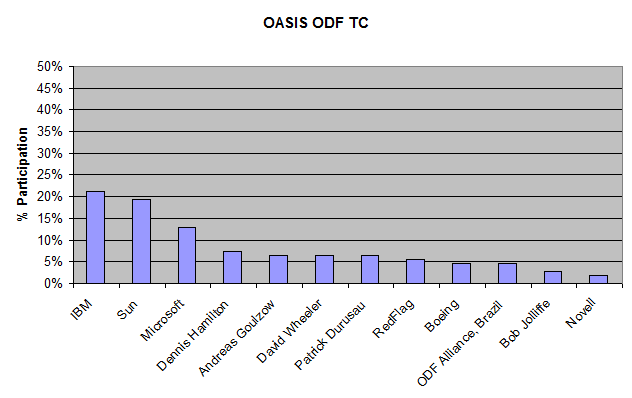
Now don’t get me wrong. There are certainly some independent people in WG4 and I would not want anyone to denigrate their efforts. They are not all Microsoft employees, consultants, business partners and research institutions that Microsoft is funding. But they are mostly so. Attend any OOXML meeting and look to your right, look to your left, and most likely one is a Microsoft employee and another is economically tightly tied to Microsoft.

Of course, I would not expect that Microsoft would be absent from this work either. After all, they authored the specification and have most of the relevant technical experts. But a glance over the attendance records shows that they are not gracing the committee with their file format gurus. Instead they are stuffing it with “program managers” and “technology directors” and other assorted non-experts. The problem appears to be that their file format experts are all cursed with American residency and so have little value in stuffing a committee that has one-country/one-vote rules. Thus the spectacle of a room filled with Microsoft employees wrapped in different colored flags.

So I don’t think one can truthfully say (in Jason’s words) that it is “patently untrue” that Microsoft controls OOXML. Or that OOXML “control and maintenance” is “independent of Microsoft” as Jerry promised it would be, or that the “global community would be in control” as Chris said. I don’t think those are accurate statements, given the evidence. I think the results fall far short of what was promised back when Microsoft were trying to secure a positive vote in ISO.

And this is not just me complaining. At the recent SC34 Plenary meeting in Seattle, delegates from several NBs approached me, voicing concerns at the domination Microsoft was asserting over the committee. (Perhaps this explains the substantial number of people who attended only one WG4 meeting and then never returned?) There is no easy solution here. Remember, we are dealing with a company that has demonstrated that it is willing to spend millions of dollars to protect its Office monopoly franchise from any pro-competition standards initiative.

The Former ISO Secretary-General, when interviewed about the OOXML farce, was asked about claims of Microsoft domination and admitted that he was powerless to stop this:

Companies have no direct vote on the International Standards, which are adopted according to voting by national member bodies, on the basis of one vote per country… As a stakeholder in the process, Microsoft and other interests certainly participated in the process to establish national positions. ISO and IEC national members are fully responsible for the way national votes are formed and relevant national interests consulted.

Evidently there is no one capable of fixing this. ISO says that domination by a single corporation is not their responsibility, because only NBs vote and each NB determines its own participation rules. But individual NBs also don’t see a problem, because any single one of them only has one Microsoft employee at the meeting. So the NB itself is not necessary stuffed (although that does happens occasionally as well). So by placing Microsoft employees in many NB delegations and putting the overflow into the Ecma delegation, Microsoft can still dominate the ISO committee and not trigger a rule violation in ISO or in any NB.

This is essentially how Microsoft hacked ISO. Now that the flaw has been demonstrated, any large international corporation with sufficient funds and interest can exploit it as well. So long as the rules remain as they are, ISO is vulnerable. ISO defends this criticism by pointing out what good work they’ve done in the past, and how they rarely have problems of this kind before. But this shows little appreciation for the nature of the problem which have been demonstrated. It is like arguing that a newly discovered (though long latent) security flaw in an operating system is insignificant because you’ve never had an attack before now. Of course, this misses the point entirely. Once the vulnerability is known and publicly exploited, you’re living on borrowed time until you can secure the system. Today ISO is living on borrowed time and is very close to becoming a Microsoft-infested zombie committee.


That is all for Part I of this update. In the next Part I’ll look at the maintenance of OOXML, and the most peculiar way in which the Microsoft-dominated committee is putting aside BRM decisions and making other breaking changes to the specification, in an bizarre attempt to make ISO OOXML conform to to the Microsoft Office standard.

Reblog this post [with Zemanta]

Filed Under: OOXML Tagged With: Ecma, ISO, JTC1/SC34, Microsoft

What’s New in ODF Maintenance?

2009/09/17 By Rob 7 Comments

Some Q&A, in the form of a self-interview. As with anything on this blog, these are my opinions.

Question: How are you doing today, Rob?

Rob: Very well thank you. I just finished attending a good set of working group (WG) meetings, and the Plenary meeting of ISO/IEC JTC1/SC34 in Seattle, Washington.

Question: Anything newsworthy to report?

Rob: Most of the meeting was routine, moving various documents forward, inch by inch, at the glacial pace we expect from ISO. But one noteworthy event this week was the first meeting of SC34/Ad Hoc Group 3.

Question: What is Ad Hoc Group 3?

Rob: Ad Hoc Group 3, or “AHG3,” is an temporary working group that was charged with determining how SC34 would fulfill its maintenance obligations relating to ISO/IEC 26300, the ISO/IEC transposition of the ODF standard. Francis Cave, of the UK, presided over the AHG3 meeting, which was well attended by 20 or so delegates.

Question: What do you mean by “maintenance”?

Rob: In this context maintenance refers to the activities that occur between major revisions of a standard, primarily the collection of defects, and the approval and publication of corrections.

Question: So what did Ad Hoc Group 3 do?

Rob: AGH3 met for around 8 hours over two days. Its most notable act was to orchestrate its own dissolution, by proposing that a new, permanent working group, WG 6, be created by SC34 to carry out pretty much the same charge given to AHG3. WG6 will likely also have the same Convenor and participants as AHG3.

Other than that, the primary benefit of the AHG3 meeting was to bring everyone up to speed on the current state of various ODF defect reports and errata documents, and to discuss ways in which we can better align the ISO/IEC version of ODF and keep it in alignment, with the OASIS version.

Question: So who owns ODF maintenance?

Rob: The OASIS ODF TC owns the maintenance of the OASIS ODF standard, and WG6 will own this activity for the equivalent ISO/IEC text. However, neither committee has absolute freedom of action, both being governed by applicable procedural rules of their parent organizations, as well as various joint agreements between OASIS and JTC1.

Question: Won’t this lead to a divergence of the OASIS and ISO/IEC versions?

Rob: It is a stated goal of JTC1 that ISO/IEC 26300, as the PAS transposed version of ODF, remain in sync with the OASIS version of ODF. This goal is shared with OASIS. OASIS and JTC1 have jointly approved a set of maintenance principles which call for the OASIS ODF TC to take the lead on maintenance.

Although we have not worked out all the details, a natural way to avoid divergence is to treat this as a two-phase process:

  • Defect reports from SC34 are submitted to the OASIS ODF TC
  • Corrections originate in the OASIS ODF TC, and are then transmitted to SC34

Question: But that doesn’t guarantee that these texts will not diverge, right?

Rob: At the very least there will be a delay between the correction of the OASIS version of the text and the publication of the ISO/IEC version of the correction. This delay will typically be around 5 months. If both OASIS and SC34 adhere the agreed maintenance principles, any divergence should amount to no more than such a delay.

Note that we already have some degree of divergence. For example, OASIS published ODF 1.0 Approved Errata 1.0 in November 2008, and submitted these changes to SC34 where they have not been acted on. And OASIS published ODF 1.1 back in early 2007 and has failed to submit these changes to SC34. Although there appears to be no adverse market effects from this degree of divergence, both sides agree that this is not an ideal situation and have agreed in principle to take steps to remedy this situation.

Also, we shouldn’t worry about the possibility of intentional or malicious divergence, since careful consideration of the ownership of the copyright and trademark for the ODF standard, as well as terms governing any associated patent claims, suggests that any rogue attempt to fork the ODF standard would be fraught with peril. ISO/IEC 26300 may lag OASIS ODF, but it cannot go beyond the corresponding OASIS text in any substantive way.

Question: So what role does WG6 have then?

Rob: SC34 has several WGs, each dealing with a different standard or group of standards. This WG structure is important for National Bodies, which often allocate their resources (personnel, travel budgets, etc.) at the level of a WG. It is also a logistic convenience for scheduling meetings.

WG6’s charter sounds impressive, “All SC 34 projects and activities relating to the maintenance of ISO/IEC 26300 OpenDocument Format”. However, since JTC1 has already assigned coordination of ODF maintenance to the OASIS ODF TC, it is not clear what, if any, residual tasks remain for WG6 to perform. But even if its official responsibilities are minor, WG6 does serve a useful purpose as a focal point for SC34 technical experts having an interest in ODF. Under the aegis of WG6, these experts might, for example, create defect reports for submission to OASIS and give feedback on OASIS draft corrigenda.

Question: But what about contributions in the other direction? How do SC34 technical experts contribute to ODF?

Rob: As stated in the joint memorandum of principles between OASIS and JTC1: “National Body input, including but not limited to the submission of defects and amendments, can best be achieved by the participation of JTC 1 experts in the ODF TC of OASIS”.

The exact answer will depend on your specific goal. If you participate via SC34, your opinion will count as one vote on your NB delegation, and in turn your delegation will have one vote among many NBs in SC34, which amounts to one source of feedback, among many others, to the OASIS ODF TC. So essentially you will have a much diluted and rather indirect way of expressing your thoughts on the technical work of the OASIS ODF TC.

Or you could join OASIS and and the ODF TC directly, as an individual member, in which case you can contribute directly in our work and your vote will be equal to mine or any other member of the ODF TC.

So if your priority is to present a national view via national body participation, then by all means participate via SC34 and WG6. This is also good if your priority is racking up frequent flier miles via attendance at international meetings. But if you are looking for the most effective way to contribute directly to the standard, then you cannot do better than joining the OASIS ODF TC. This is probably why nine members of JTC1/SC34 already are OASIS ODF TC members.

Question: So we’ve talked so far about maintenance. But what about major revisions, such as ODF 1.2, how are they handled?

Rob: Major revisions developed in OASIS may be submitted to JTC1 via the PAS transposition process. This results in a JTC1 ballot and does not directly involve SC34 technical experts, although in some cases the SC34 national “mirror committee” may be consulted by their NBs in the preparation of a national position on the PAS ballot. In any case, WG6 would have no formal role in this process, nor can I imagine an informal role for them.

Filed Under: ODF

A Standard I Would Use: Auto Unsubscribe

2009/08/19 By Rob 8 Comments

I don’t get a lot of spam, at least not in the traditional sense of “unsolicited commercial email”. But I do get a lot of solicitations from online retailers with whom I have done business. As we all know, even a single order can trigger weekly emails. Multiply that by all places I do business with, and I end up with a lot of unwanted emails.

Certainly, the vast majority of these companies offer an unsubscribe option, with instructions clearly marked at the bottom of the email. These instructions tend to have a URL which I click and one of three things happen:

  1. Link automatically unsubscribes me
  2. Link takes me to a web page that asks for confirmation and maybe a little survey, or a list of mailings which I can opt-in or out of.
  3. Link takes me to a login page, where I need to remember my login id, navigate to a profile and perform several other steps before I can unsubscribe. I have some mailing lists that I have never been able to unsubscribe to at all. I end up defining inbox rules to delete the mailings altogether.

The idea for a standard is this: Can we encode these unsubscribe mechanisms, or at least the first two mechanisms, in a standard way in the mail message itself, so that an email client can allow the user to simply push a button and activate the unsubscribe procedure? If done right, I could even be in my inbox view and select several emails and unsubscribe to those lists all at once. Ideally no further user interaction would be required. And certainly I want to avoid the requirement to hunt through an email for the unsubscribe link.

Since emails can come in a variety of formats, from text, to HTML to RTF, it might make sense to handle this in the mail headers rather than the email body itself.

Of course, we want this to be simple and declarative and not require general-purpose scripting support, for simplicity and security reasons.

I think this would be a relatively simple standard to create. We just need some conventions for an email to declare a RESTful API for unsubscribing to a list.

Of course, maybe there is something like this already out there?

Filed Under: Standards

How Not to Read a Patent

2009/08/13 By Rob 11 Comments

There is perhaps no occasion where one can observe such profound ignorance, coupled with reckless profligacy, as when a software patent is discussed on the web. Note the recurring pattern, which is repeated every two weeks or so. A patent issues, or a patent application is published or patent infringement suit is brought, and within minutes the web is full of instant pundits, telling us what the patent covers, how it should not have been granted, how it is entirely obvious, or how it applies to everything in the world, and how it presages a self-induced mutually assured destruction that now leads us on to the plains of Armageddon. If I had a nickel for every time this happens…

By way of disclaimer, I am not a lawyer, but I am blessed that my self-avowed ignorance in this area is coupled with a certain knowledge of the limits of my understanding, a handicap seemingly not shared by many other commentators. I know what I do not know, and know when to seek an expert.

In the past few days we have had a bumper crop of pontification on the significance of two XML-related patents, one newly issued to Microsoft (7,571,169), and another older one (5,787,449) owned by i4i, whose infringement has resulted in a large judgment and injunction against Microsoft. I’ve found the web coverage of both patents to be an unmitigated muddle.

I’m not going to comment on the merits of either one of these patents, but I’d like to make a few basic observations that may be of some assistance to those who comment on future patent issues.

  1. A patent has a description known as the “specification”. And it has a list of numbered “claims”. Although the specification can define terms that are then referred to in the claims, it is the granted claims that define the scope of the patent, not the specification.
  2. If all you do is read the abstract and the first few paragraphs of a patent, then you may know the general topic of the patent, but you do not really know its scope. If you then go off and cry, “Oi vey, this patent covers XHTML, SVG, RDF, Pringles and Obama Healthcare Plan” then you do your readers a disservice. You must parse the very specific and often obtuse language of the claims in order to understand exactly what a patent covers. There is no short cut. This is not like a book where you can understand the plot by reading the back cover. But over and over again, I see people who just read the abstract, maybe glanced at a diagram, and then feel equipped to hold forth at length on the substance of the patent.
  3. When you try to understand patent claims, you will encounter a dense form of legal English. Claims are not written for a layperson and do not presume that you will understand it easily. The drafting of patent claims is a black art, like writing device drivers, and if you are not versed in its intricacies, then your statements on any given patent are apt to be wide of the mark. Claims are full of magic words. Know what you do not know. If you do not recognize at sight and know the interpretation requirements of a means-plus-function claim (which is key in the ‘449 patent), or you are not crystal clear on the distinction between the verbs “consist” and “comprise”, then you probably should not be the first (or loudest) person to speak on what a patent claims.
  4. If you are reading an application, know that during the “prosecution” of that patent, when it is reviewed by the USPTO, some of the claims of the patent may be thrown out, for any of several reasons, including prior art identified by the examiners. However, the specification of the patent is unlikely to change much. So an issued patent often has a very broadly-written specification, that covers the entirety of the originally claimed invention, though the the issued patent might have only a subset of the original claims allowed. So if you are have an issued patent and you look at only the specification, you can easily be fooled into thinking it covers far more than it does. For example, the ‘169 patent from Microsoft had half the original claims thrown out in the prosecution. If you don’t know that and are reading only the specification, not the granted claims, then you will incorrectly think the patent is far broader than it actually is.
  5. Know what a priority date is, and how that is affected by a continuation. I’ve read all sorts of nonsense based on not appreciating that. Take a look at the ‘169 patent, for example. It says it was filed in 2004. But if you look closely you see it was a continuation of a 2002 application. You can moan and groan all you want about prior art, but if you don’t get your dates right you’re off to a bad start in your analysis.
  6. In an infringement suit, like with the ‘449 patent, be sure to look at the actual court record. Typically there is a Markman (claim construction) hearing, where the court will determine the meaning of terms used in the patent claims. If you have not read the court’s claims construction opinion in the i4i versus Microsoft case, then your commentary is uninformed by probably the most important document in this case (well, next to the patent itself).

Well, that’s enough for tonight. Repent. Sleep on it. And realize that making sense of a complex patent takes time, if you’re going to do it right. Ergo, the first impressions you read from the instant pundits on the web will tend to be shallow, imperfectly informed and often wrong. Heck, even everything I said in this post may be wrong.

Filed Under: Intellectual Property Tagged With: i4i, Microsoft Word, OOXML, Patents

ODFDOM 0.7 Released

2009/07/21 By Rob 2 Comments

I’m pleased to report that the 0.7 release of the ODF Toolkit Union’s ODFDOM library has just been released. This is an open source (Apache 2.0 license) Java toolkit for programmatically reading, writing and manipulating ODF documents. The code is 100% Java and does not require that you have OpenOffice or any other ODF editor installed. It operates directly on the document itself.

You can download the JAR and JavaDoc from the distribution here. You will want to go through J. David Eisenberg’s tutorials on ODFDOM as well.

If you sign up for a Toolkit Union account, you’ll be able to participate in the user’s mailing list (users@odfdom.odftoolkit.org) where we welcome your ideas, bug reports and patches. Or better yet, move over to the dev list (where the real fun is) and contribute actively!

The ODF Toolkit also has an active “Conformance Tools” project, including the ODF Validator, and our most-recent project, AODL, which is a .NET/C# module.

At the Toolkit Union we’re able to host more such ODF-related toolkit projects, in other programming languages. I don’t see any good reason to have two Java API’s for ODF, but I’d love to see broader coverage, especially in some of the more-widely used scripting languages like Python or Perl. I have even seen some interest in a PHP/ODF module. I think there is some advantage to getting a “critical mass” of programmers interested in working with ODF together in one place to bounce ideas off of each other. So if you are interested in joining this effort, sign up at the Toolkit Union’s web site, or send me a note if you want to talk first.

[22 July 2009 — more on ODFDOM 0.7 in this post by project lead Svante Schubert]

Filed Under: ODF

  • « Go to Previous Page
  • Page 1
  • Interim pages omitted …
  • Page 24
  • Page 25
  • Page 26
  • Page 27
  • Page 28
  • Interim pages omitted …
  • Page 69
  • Go to Next Page »

Primary Sidebar

Copyright © 2006-2026 Rob Weir · Site Policies