• Skip to primary navigation
  • Skip to main content
  • Skip to primary sidebar

An Antic Disposition

  • Home
  • About
  • Archives
  • Writings
  • Links
You are here: Home / Archives for 2006

Archives for 2006

Traduttore, Traditore

2006/07/13 By Rob 7 Comments

Brian Jones in his blog entry of 11 July 2006, comments on their recently announced ODF Translator:

It’s directly exposed in the UI. We’re even going to make it really easy to initially discover the download. We already need to do this for XPS and PDF, so we’ll also do it for ODF. There will be a menu item directly on the file menu that takes to you a site where you can download different interoperability formats (like PDF, XPS, and now ODF).

Heck, if you wanted to be even more hardcore, the Office object model allows you to capture the save event. So if you wanted to you could make it so that anytime you hit save you always used the ODF format, just by capturing the save event and overriding it. I’m not expecting folks to do that, but it does show just how extensible Office really is.

One might ask, is it a “hardcore” view to want ODF to be the default format for documents saved in Office? Isn’t this exactly what Massachusetts ITD requested in their RFI?

What Jones does not say is that Word 2007 puts the ODF format at a disadvantage, making it harder than necessary to work with. Although end users are given a simple and direct UI for changing the default file format in Word 2007 to other file formats such as RTF, DOC or even ASCII text, ODF is not allowed as a default. Why should ODF users be forced to use “hardcore” programming to capture the “save event” to accomplish this same task?

Let’s take a look at the UI we’re given. Screen shots are based on Word 2007 Beta 2, and the ODF Add-In for Word 2007.

Launch Word, create a document and try to save it, using the File Save menu, or the age-old familiar short cut, Control-S. What do you get? See the following screen shot for the familiar File Save dialog. Although Microsoft formats like DOCX, DOC and XPS are available, as well as export formats like PDF, HTML and Plain Text, you will not find ODF listed.
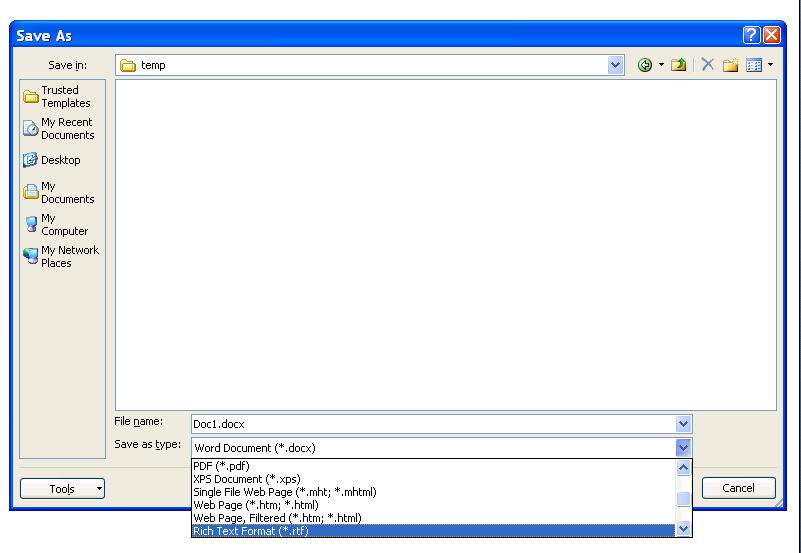
One new twist is the “Tools” button added to the Save As dialog. Pressing that reveals new options including something called “Save Options” which looks like this:
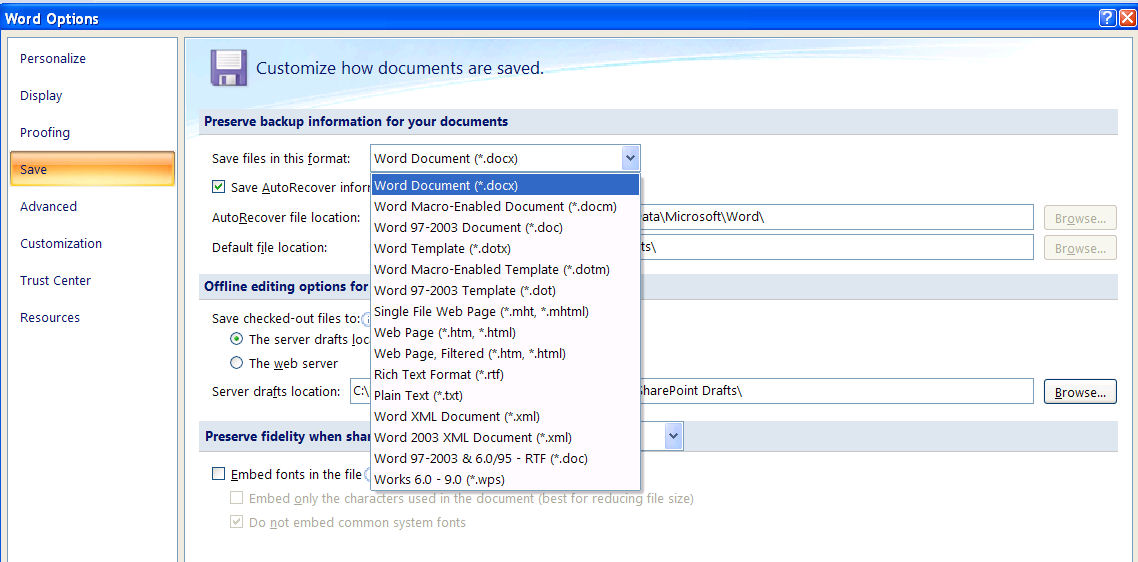
Here we see how Microsoft treats the file formats it favors with first-class support. Word 2007 allows you to choose which file format will be the default format when you save a document. You can keep the default format (Draft Office Open XML) or choose the legacy binary DOC format, HTML, or older formats like RTF or even Plain Text. But you will not find the ISO OpenDocument Format on this list.

So the question to ask is why Microsoft integrates ODF in a way which treats it as a 2nd class citizen, treated less favorably than even Plain Text?

  • ODF cannot be made the default format
  • ODF documents can not be round-tripped
  • ODF documents are not accessible via the familiar keyboard shortcuts for opening and saving files (Control-O and Control-S)
  • ODF documents pay a performance penalty for having to be indirectly converted via Draft Office Open XML rather than via native support

[ 7/2/6/2006 The integration discussion continues here]

Filed Under: Office Tagged With: ODF, ODF Add-in

50 years ago

2006/02/15 By Rob 1 Comment

I find it interesting to take a look back at the commemorative stamps issued in 1956. What do we choose to remember, and how do we remember it?

For example, 1956 was the 100th anniversary of the the birth of Booker T. Washington, a great leader in education and civil rights, founder of the Tuskegee Institute in Alabama. He was first honored on a U.S. postage stamp in the Famous Americans series of 1940, with a head and shoulders portrait.

But in 1956, the centennial celebration, how was Booker T. Washington honored?

This stamp, issued April 5th, 1956 was designed by Charles R. Chickering, artist at the Bureau of Engraving and Printing. When I first saw this stamp, my reaction was immediate. Where is the portrait? 1956 was the centennial of the birth of the man, not the anniversary of a log cabin. I found this odd.

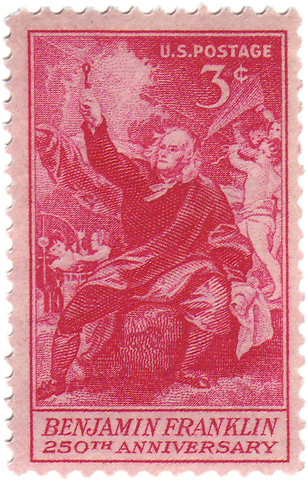
The other person honored in 1956 was Benjamin Franklin, on the 250th anniversary of his birth. This design in bright carmine (also by Chickering) was based on the painting “Franklin Taking Electricity from the Sky” by Benjamin West and was issued on January 17th, 1956.

2006 is the 300th anniversary of Franklin’s birth, and a set of 4 stamps is due to be issued April 4th. You can see the planned designs here.

Filed Under: Philately

Epithets

2006/01/16 By Rob 1 Comment

A few thoughts on the Epitheton Ornans, or ornamental epithet. This is more than a nickname, but a formalized word or phrase associated with a person. Classical epic poetry makes heavy use of this rhetorical device. For example, in Homer Achilles is often referred to as “podas okus” or “swift-footed”, whereas Agamemnon is often “anax andron” or “ruler of men”. There is internal evidence that these poems used a stock list of epithets of different lengths and stress paterns to fit into whatever metrical context was needed. In this way, the epithets could aid improvized oral performance, much as a jazz musician has a repetoire of riffs and chord progressions at his command which can be inserted to fill out a phrase.

The Romans allowed the honor of an “agnomen” for significant military victories. So Publius Cornelius Scipio, after defeating the Carthaginian Hannibal, became Scipio Africanus. Over the centuries, this trend escalated. So, by the 4th Century A.D., we have awe-inspiring names such as “Imperator Constantinus Maximus Augustus Persicus maximus, Germanicus maximus, Sarmaticus maximus, Britannicus maximus, Adiabenicus maximus, Medicus maximus, Gothicus maximus, Cappadocicus maximus, Arabicus maximus, Armenicus maximus, Dacicus maximus”. (Today We just call him “Constantine the Great” which is a great time-saver)

The trend continued. If you’ve seen an old British penny, from 100 years ago, you would read the legend “VICTORIA D G BRITT REG F D”, short for “Victoria, by the Grace of God, Queen of England, Defender of the Faith”.

But the use of epithets has been on the wane for many years now, at least in the optimistic parts of the world. North Korea may have its “Dear Leader” and the late “Great Leader”, but we never even considered formally naming Eisenhower “The German Slayer”. We ended up with “Ike”. I guess we like our leaders to be mere men, and not gods. The Cult of Personality is difficult to maintain in a democracy with a free press. “No man is a hero to his butler”.
Sure, we have our little nicknames, “The Artist formally known as Prince”, “Iron” Mike Tyson or the “Scud Stud”, but that is done in jest, or in the entertainment world (which amounts to the same thing). We will never see “Scud Stud” carved in marble or engraved in brass.

But once a year, on this date (or the nearest Monday) I am reminded of the most prominent example of epitheton ornans in common use today. I refer to the ubiquitous use of the phrase “Slain Civil Rights Leader”. The fact that I do not need to name the owner of this epithet demonstrates its currency. A search of Google News shows almost 1,500 uses of this phrase in recent press clips. This epithet is so tightly associated with him that can be used as a substitue for his name, much as a medieval scholar could speak of “the Philosopher” to refer to Aristotle without ambiguity.

I’m trying to think of any other prominent examples of such epithets in common use today. I can’t think of any. Can you?

One wonders how long this epithet will remain? Will it outlast the generation that heard his message and headed his Dream? We can hope so. But I do note that in the generation after the assasinations of Lincoln, Garfield and McKinnley, all three were popularly acclaimed with the epithet “our martyred president”. But a search of Google News shows zero hits for “martyred president”, though there are 271 hits for “President Lincoln”.

Filed Under: Uncategorized

Ptolemy IV, Philopator

2006/01/15 By Rob 2 Comments

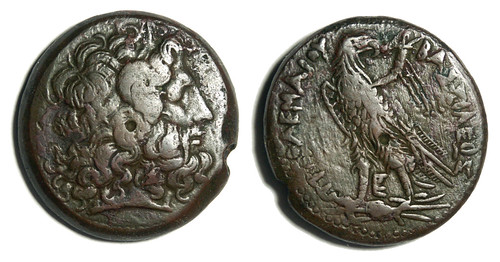
photograph of coin, obverse and reverse
Coin of Ptolemy IV, Philopator

The word is “deaccession”, a fancy way of saying a museum is selling off a portion of its collection. This can happen for many reasons. For example, the museum may have received a bequest that was outside the parameters of its collection, it may have acquired items in the past that are now outside of the museum’s mission, or it may sell off some lesser works in order to raise funds to acquire a more significant piece of art. In any case, the Boston Museum of Fine Arts deaccessioned a number of ancient coins, one of which I was able to acquire, and which you see above. A close up view is here.

The obverse of this coin features a bust of Zeus/Ammon facing right. This was a composite god, conflating the chief Egyptian and Greek deities, under the Alexandrian practice of syncretism.

The reverse shows an Eagle grasping a thunder bolt, with a cornucopia under the rear wing. The legend reads ΠΤΟΛΕΜΑΙΟΥ ΒΑΣΙΛΕΩΣ or “of Ptolemy, (the) King”.

You may notice the small central pit on each side of the coin. This is called the “centration dimple”, and is an artifact of the production method.

This particular coin type is a well-known type from Ptolemy IV, who reigned from 221 BC to 204 BC. The Ptolemies were the Greek/Macedonian rulers of Egypt in the period after the death of Alexander the Great and before the rise of Roman control. By all accounts Ptolemy IV was an ineffectual leader, more interested in orgiastic rituals than ruling the nation. His one notable military victory was at the Battle of Raphia in 217 BC where he defeated the troops of the Seleucid King Antiochus III. In this battle, Ptolemy supplemented his Greek army with native Egyptians trained as phalangites. This infantry advantage proved decisive, and Ptolemy won the day, preserving Syria and Palestine in Egyptian hands. This was a mixed blessing, since the Ptolemaic dynasty, foreign rulers of Egypt, had now to contend with the newly armed and trained Egyptians, as well as external threats.

The reign of Ptolemy IV, including the Battle of Raphia, as seen from the perspective of an Egyptian Jew, is told in 3 Maccabees, a book canonical to the Bibles of Eastern Orthodox churches, though apocryphal to others.

One last close look at the coin. Notice the “Ε” between the eagle’s legs? This the “regnal date”, giving the year according to the year of the rules reign. Epsilon (Ε) was the 5th letter in the Greek alphabet. This would this correspond to 217BC, the year of the Battle of Raphia. So, a nice piece of history.

Filed Under: Numismatics Tagged With: Battle of Raphia, Boston Museum of Fine Arts, Egypt, Ptolemaic dynasty

Jingle Bells, Batman Smells

2006/01/09 By Rob 519 Comments

I’ve been reading Games and Songs of American Children by William Wells Newell, a Dover reprint of the 1903 edition. I find it fascinating how games are transmitted from generation to generation, games like “Tag”, “Button button who has the button?”, “The church and the steeple” or “Odd or even?” These games are not learned from teachers in a school, or read in a book, or typically even taught from parents. For the most part they are transmitted from child to child, from an older sibling, or a peer, through the most casual pathways.  Games like this have spread across the country and beyond without any overt effort. In a way, it is like language.

So, that made me think about the “classic” children’s Christmas parody of “Jingle Bells, Batman Smells”. I assume there is no part of this country where these words are not known to every child. But it exists in no songbook. Who first sang these words, and when and where was it done? How fast did it travel? I think if a sufficient survey was done of adults of various ages, as to when and where they recall first hearing these lyrics, one could reconstruct the migration of this bit of modern folklore. Those who heard it earliest would have heard it closer to its source.

It would help my little research if any old-timers (say over 40 years old) left a comment indicating what version you heard first, where you heard it (town and state) and approximately what year you heard it. I’d like to figure out what the original version truly was, and where it came from and how fast it spread.

There are several variants of this song. The one I grew up with was:

Jingle Bells, Batman smells
Robin laid an egg.
The Batmobile lost a wheel
and the Joker got away (Hey!)

Other commonly reported versions include:

Shotgun shells, Santa smells,
Rudolf ran away,
Oh what fun it is to ride
in a beat-up Chevrolet!

or

Jingle bells, shotgun shells,
Santa Claus is dead,
Rudolf got a .22
and shot him in the head.

or

Jingle Bells, Shotgun Shells,
BB’s in the air.
Oh, what fun it is to ride
in Santa’s underwear!”

or

Jingle Bells, Batman smells
Robin laid an egg,
The Batmobile lost a wheel,
and the Joker joined ballet , Hey!

Check the comments for other variations. Some have alternate lyrics to the verse as well as the chorus.

Also, if you are interesting in crazy Christmas music, then here are two CD’s, filled with zany holiday classics, for your consideration:


12 December 2015 Update

Nine years after I wrote this post I was prompted by Robert Evans over at Cracked to offer updated thoughts on the question of the origins of “Jingle Bells, Batman Smells.”  We both went through the comments on this post, correlated the dates and places, and I then did further research in newspaper archives to try to locate the earliest printed occurrence of these lines.   What we found out might surprise you.  More over at The Secret True History of “Jingle Bells Batman Smells.”

Filed Under: Music

  • « Go to Previous Page
  • Page 1
  • Interim pages omitted …
  • Page 7
  • Page 8
  • Page 9
  • Page 10
  • Go to Next Page »

Primary Sidebar

Copyright © 2006-2026 Rob Weir · Site Policies