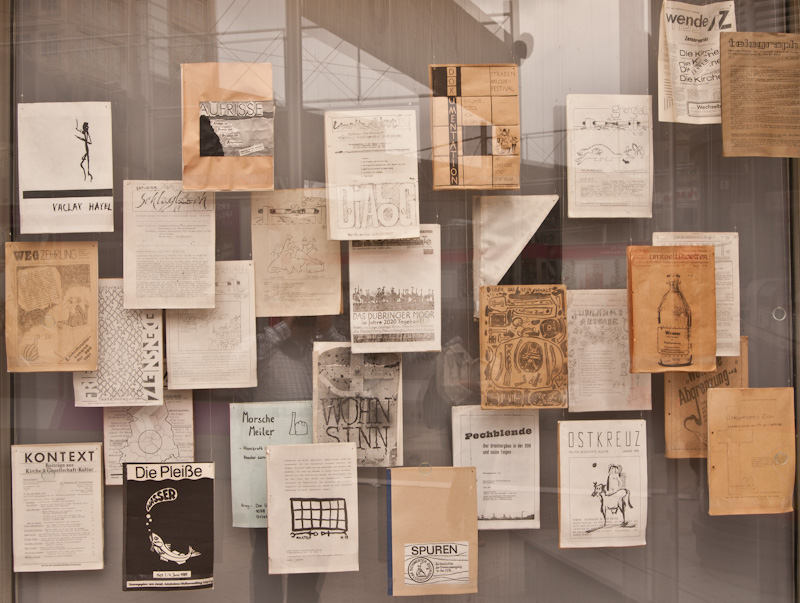
While in Berlin for the LinuxTag 2010 conference a couple of months ago, I took the opportunity for a 8-mile long meandering walk across the city, from Warschauer Strasse and the East Side Gallery to Wittenbergplatz and KaDeWe, taking in the various historical sites along the way. It was a great refresher course in 20th century European history. I especially enjoyed the free outdoor exhibit in Alexanderplatz, which dealt with the Revolutions of 1989 with a focus on the various dissident movements and publications in the DDR. Most were self-published, stealthily distributed samizdat newletters, copied laboriously using typewriters and carbon paper, primitive printing presses, or toward the end, some personal computers smuggled in from the West. They had on display an Amiga 500 and an NEC Pinwriter P6 used in 1989. Through “advanced” technology like this, document production could be raised from a few hundred to tens of thousands of copies.
As I looked at this display of samizdat publications, each a sign of struggle, technical and political, I was smug. Surely, all of this is irrelevant today? The march of technology has now put within each of our hands tools that are orders of magnitude more efficient and effective than any underground publication of 1989. With the Web, and WordPress and Twitter and YouTube and other services, we can instantly get a message out to millions of people. We are far more advanced now.
Or so I thought for a few brief minutes, until the horrible truth struck me as I considered the question more deeply. No, technology has not made dissent safer. We are merely fortunate that the political climes of 2010 permit more dissent. But if challenged, the powers that be have far greater tools to control information than they did in 1989. I am not certain the tools available to the individual come close to being able to withstand them.
I strongly believe that the capability for citizens to dissent is an essential complement to fallible leadership. And all leadership is fallible. Without such capabilities, transitions of power may be less frequent, but they also may be far bloodier.
Note that I say “capability” for dissent. I don’t mean that all forms of dissent should be legal. Certainly this is a good thing as well, and is enshrined in the constitutions of many democracies today. But I mean something more fundamental, the capability of individuals and groups to organize and express dissent, even when this goes against the law. It is almost axiomatic that a regime slouching toward oppression will, at an early stage, declare dissent illegal. History has shown this to us repeatedly. So the capability to express illegal dissent is in some sense even more important than the ability to express dissent legally.
Through the 20th century there were many attempts to reduce capabilities to express dissent, from outlawing of opposition political parties, to shuttering independent newspapers, to mandatory registration of typewriters. These all made dissent more difficult and riskier, but they did not remove the capability. It was still possible, for one person, or a group of people, to organize in secret and get their message out. They did it illegally, and at their own peril. But that was enough to start the wheels turning. If 10 people protest, they are called insane and carted away to the hospital. If 1,000 people protest, tear gas is used and people are sent to prison, But if 100,000 protest, then governments fall. In a sense the gamut from civil war to an open democratic election, including a nationwide protest someplace in the middle, are all proxies for the use of force. There are bloody and bloodless ways of determining the majority opinion, and prudence suggests not eliminating the opportunity to use bloodless methods.
My sad observation is that we are quickly reaching the point, perhaps for the first time in history, where governments will have the means to eliminate even the capability for illegal dissent. I believe this is a destabilizing threshold to cross.
Consider the following thought experiment. Imagine we are back in 1985, back in the DDR, but instead of typewriters, you have all the 21st century technological facilities, the internet, Twitter, Youtube, etc. You are a dissident and I am the government.
Your two main tasks are:
- To collaborate electronically with trusted parties, while protecting the contents of the communication, as well as the identities of the other parties.
- To publish information anonymously or pseudonymously for public consumption
You wouldn’t be much of a dissident leader if you didn’t attempt those two tasks, and I wouldn’t be much of an oppressive regime if I did not try to stop you!
So where should I start?
- A private national network. Think North Korea.
- A Great Firewall.
- Mandatory registration of computers, internet accounts
- Control of DNS
- Control of search
- Control of Certificate Authorities
- Invisible tagging of paper/ink
- Software monoculture that provides a single point of government control
- Limits on how many emails can be sent. One might argue in favor of this as an anti-spam measure. But also prevents effective organization.
- Outlaw strong cryptography.
- Reduce due process, making it trivial to subpoena ISP records without judicial review
- Make circumvention technology illegal
- Copyright — prevent fair use, Creative Commons, etc., extending copyright to government records
The interesting thing is how far we’ve gone down this road, especially at the behest of the recording industry and the copyright lobby.
What capabilities do you have on the other side? What are your abilities to express dissent?
I think the example of Wikileaks quickly comes to mind. That shows one example of a web site, that through technical and jurisdictional means, appears to have avoided take-down by a far more powerful entity, at least so far. However, I think this is a Pyrrhic victory. The mere existence of Wikileaks will spur governments to tighten laws, invest in additional counter-information technologies, such as the Internet “Kill Switch” proposed by the Department of Homeland Security in the U.S., etc.. The presence of a presently uncontrollable voice will surely lead to a concentration of control of the choke points of the internet that will eventually silence that voice.
When an irrepressible force meets an immovable object, one may speculate which will win. I put my bets on the side with the money and the guns. The danger for the rest of us is that in their attempts to control a venue for indiscriminate, absolute free speech, they devise such choke points that they provide the ability for future regimes to crush dissent, and by eliminating dissent also eliminate the best opportunity we have for peaceful revolutions.
Of course, I do not advocate sedition. And I’m not an advocate of absolute free speech. There are copyright laws, there are privacy concerns, there are military secrets, there is child pornography. These all trump free speech. But I think that means that we make these activities illegal and vigorously prosecute those who break these laws. But we should be seeking the minimal technical means necessary to detect the violators, without introducing such technologies that, to the level of a mathematical certainty, eliminate the ability for these activities to take place. Because, if we do so, we also at the same time introduce mechanisms that can be also used to crush political dissent. These technologies may first be promoted under the banner of “national security” or “protection of intellectual property”, but that is just their purported intent, not their technological limitation.
One would need to be a rather poor student of history not to notice that for several times in the past century governments have occasionally lapsed and ended up a wee bit overzealous in their attempts to secure a high degree of visible consensus among their citizens. When this happen, it is good to have several avenues to pursue honest and forthright discourse. Certainly one doesn’t want to make it too easy to topple an established form of government, but neither does one want to make it mathematically impossible. You want to bias the balance of rights toward stability, while acknowledging that the forces of revolution are forces of construction as well as destruction. We have 400 years or more of experience balancing free speech with legitimate needs of governments to declare some speech illegal. To date this has been done without the concentration of technical and administrative control sufficient to effect absolute prior restraint. This is changing. The unintended consequences of having such concentrated control should give us pause and make us hesitate rather than move quickly. The creation of the equivalent of an anti-free speech nuclear bomb, a big red button that when pressed will silence a class of speech, must be avoided.